
Reading through the stories of the bible in the with my son, the stories of the two books of kings were really interesting because it showed a long view of history we lack today.
Even Moses made mistakes, and upset God, and while he was blessed to lead his people out of the desert, he never got a chance to set foot in the promised land as punishment for his sins.
Many of the kings ruled justly, but decided to turn from God, and lived according to another way. Despite this, many of those kings decided to repent and accept their mistakes and change later in life, but while God decided not to destroy those Kings during their lifetime, but instead chose to take the leadership of Israel from their sons and give it to someone else, or have their sons divided so that Israel would no longer be unified.
It doesn't matter if you're theistic or an atheist if instead of looking at those stories as literal historical fact, you look at the stories as ancient wisdom passed down through generations meant to warn us to stay on a certain path or face the consequences.
Our contemporary view of history is much shorter. We've forcibly chosen to forget most of the stories of our past, both true and allegorical, that could help act as a lodestone to set our course through life based on the long history of man through many cycles of success and failure.
But even as we are doomed as a civilization to lose our way at times, there are also eras where we will find our way again, but it might take generations to do so. In the meantime, we personally need to pay close attention to how we manage ourselves, and carefully mind our business, and work with our hands and try to live in such a way that we're not too dependent on the civilization that has lost its way. The old morality didn't come from nothing -- it came about as advice on how to live in a world made up of cities and states, where you couldn't just rely on instinct any longer. The kings who lost their way weren't punished in their own lifetime, but in their children's lifetimes, and the kings who never strayed not only faced rewards in their own lifetime, but their kids were set up to become the future kings.
There was a big moment when I was writing The Graysonian Ethic that really made me feel small, but important at the same time. It was realizing that every single person who led up to my existence was a winner in a sense that they survived and reproduced. Many humans never survived long enough to have kids, and many of those kids would never have kids, but my parents, and grandparents, and great grandparents, going all the way back in a line of succession too far for us to imagine did succeed. It made me feel small because I was just the latest inheritor of wealth I can't even recognise because I was born with it -- instincts that help me succeed, that keep me alive, that help me prevent failure -- but I'm just carrying a torch for a short time I have on this earth before I must pass the inheritance on to my kids, and they in turn must pass that inheritance on, while building on that inheritance by teaching my son right from wrong.
Even Moses made mistakes, and upset God, and while he was blessed to lead his people out of the desert, he never got a chance to set foot in the promised land as punishment for his sins.
Many of the kings ruled justly, but decided to turn from God, and lived according to another way. Despite this, many of those kings decided to repent and accept their mistakes and change later in life, but while God decided not to destroy those Kings during their lifetime, but instead chose to take the leadership of Israel from their sons and give it to someone else, or have their sons divided so that Israel would no longer be unified.
It doesn't matter if you're theistic or an atheist if instead of looking at those stories as literal historical fact, you look at the stories as ancient wisdom passed down through generations meant to warn us to stay on a certain path or face the consequences.
Our contemporary view of history is much shorter. We've forcibly chosen to forget most of the stories of our past, both true and allegorical, that could help act as a lodestone to set our course through life based on the long history of man through many cycles of success and failure.
But even as we are doomed as a civilization to lose our way at times, there are also eras where we will find our way again, but it might take generations to do so. In the meantime, we personally need to pay close attention to how we manage ourselves, and carefully mind our business, and work with our hands and try to live in such a way that we're not too dependent on the civilization that has lost its way. The old morality didn't come from nothing -- it came about as advice on how to live in a world made up of cities and states, where you couldn't just rely on instinct any longer. The kings who lost their way weren't punished in their own lifetime, but in their children's lifetimes, and the kings who never strayed not only faced rewards in their own lifetime, but their kids were set up to become the future kings.
There was a big moment when I was writing The Graysonian Ethic that really made me feel small, but important at the same time. It was realizing that every single person who led up to my existence was a winner in a sense that they survived and reproduced. Many humans never survived long enough to have kids, and many of those kids would never have kids, but my parents, and grandparents, and great grandparents, going all the way back in a line of succession too far for us to imagine did succeed. It made me feel small because I was just the latest inheritor of wealth I can't even recognise because I was born with it -- instincts that help me succeed, that keep me alive, that help me prevent failure -- but I'm just carrying a torch for a short time I have on this earth before I must pass the inheritance on to my kids, and they in turn must pass that inheritance on, while building on that inheritance by teaching my son right from wrong.
We sent Disney over to Japan, they changed it and it became Anime. Next, they sent it back and this is what we changed it into.

Frankly, every single government department that engaged in censorship should just be shut down, and every single politician who pushed censorship should be censured.
Straight-up nuclear option.
Straight-up nuclear option.
I agree with Jeff on this one. Banks that are run badly collapsing is a good thing.
Our society has a big problem: People take big risks to get rich, then when they become rich they buy politicians, and when the natural consequences of taking stupid risks occur and they're supposed to lose their money and power then the politicians step in and use our money and our kids money to bail them out.
When we remove the factors that limit bad behavior such as protecting banks from collapsing under the weight of their unmanaged risk, then we break the game, and suddenly the only way to succeed is to take big risks without any regard for the consequences. It's the famous privatizing the gains and socializing the losses. Meanwhile, the people who are responsible get out-competed since there's no benefit to doing the right thing.
From this point of view, it's predictable that the collapses would get bigger and bigger and we wouldn't learn any lessons from them.
I wrote a long paper on the monetary causes of virtually every recession in the US. Limit the money supply and make fractional reserve banking difficult to abuse and you'll end up with a nice boring economy, you won't need to take everyone's money and give it to the richest people every 10 years just to prevent a collapse.
Our society has a big problem: People take big risks to get rich, then when they become rich they buy politicians, and when the natural consequences of taking stupid risks occur and they're supposed to lose their money and power then the politicians step in and use our money and our kids money to bail them out.
When we remove the factors that limit bad behavior such as protecting banks from collapsing under the weight of their unmanaged risk, then we break the game, and suddenly the only way to succeed is to take big risks without any regard for the consequences. It's the famous privatizing the gains and socializing the losses. Meanwhile, the people who are responsible get out-competed since there's no benefit to doing the right thing.
From this point of view, it's predictable that the collapses would get bigger and bigger and we wouldn't learn any lessons from them.
I wrote a long paper on the monetary causes of virtually every recession in the US. Limit the money supply and make fractional reserve banking difficult to abuse and you'll end up with a nice boring economy, you won't need to take everyone's money and give it to the richest people every 10 years just to prevent a collapse.
The fact that the world is made of shades of grey used to be uncontroversial. One of the most dangerous things I see is the pathological need to put everything on a board labelled "good" and "bad".
Not to mention that one has the backing of the entire international elite and the other has had to fight those same elite every step of the way. Scarily accurate.
The fact that people still trust the institution of science when it's this badly damaged is actually dangerous. It's a useless thing without it's most important feature, humility.
Definitely something people don't seem to realize is that this can only give you back what you've put into it.
No idea, just that it's chatgpt running off of openAI's servers. It may only be using an earlier revision for that service.
They're not just being petty because they don't like him because the teevee told him he's bad, nope nosireebob.
Which is why they're locking up Al Gore too! (Right?)
Which is why they're locking up Al Gore too! (Right?)
I'm not CS/IT, but I'm adjacent to both. I haven't been impressed with the code I've asked chatgpt to write. Often it produces code that won't even compile, it doesn't know APIs so it just makes shit up that seems like it should be right, and it seems to spit out exactly what I'd expect from an algorithm designed to make stuff that looks like it should be correct but doesn't need to be.
If this level of work represents the base level from a CompSci student in 2023, then most CompSci students should have been failed out of their respective programs.
If this level of work represents the base level from a CompSci student in 2023, then most CompSci students should have been failed out of their respective programs.
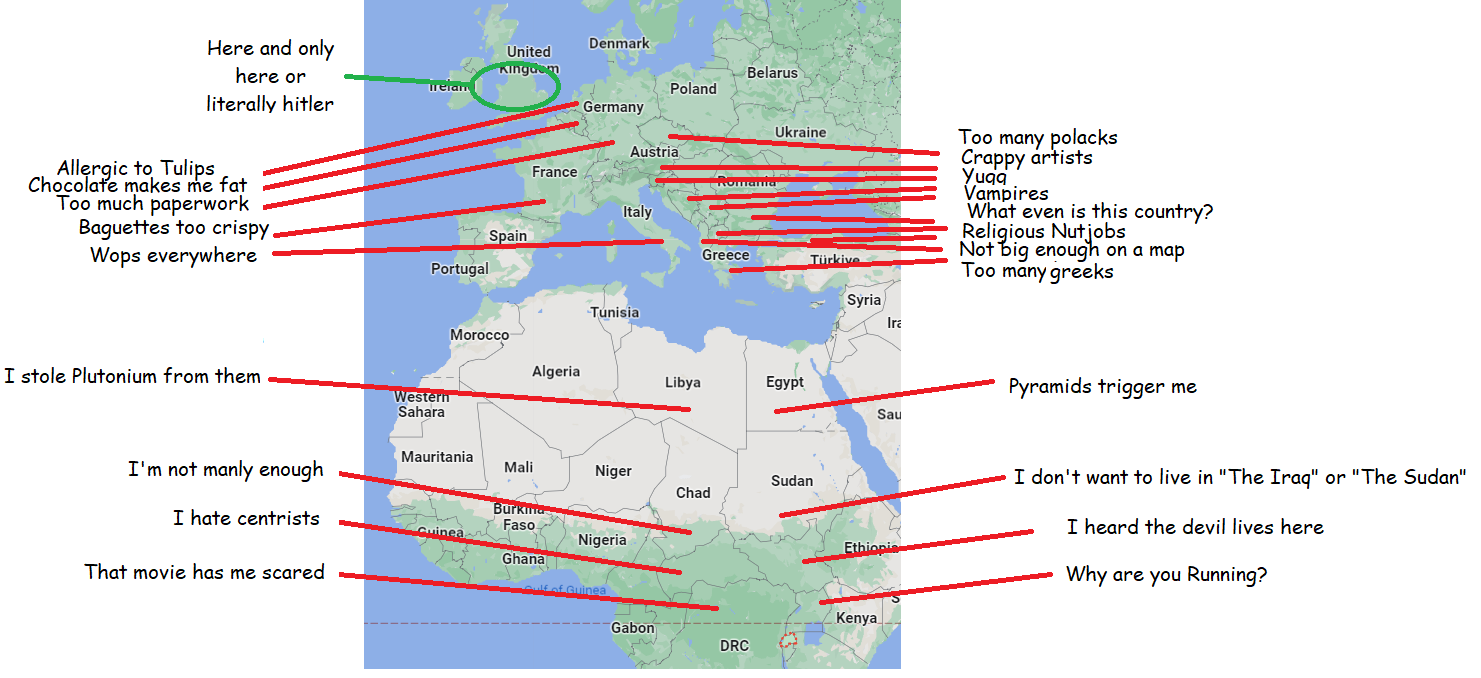
Seems to me that ChatGPT got the answer wrong (as often happens with complicated questions). Poland as a country may have a long history, but unlike Switzerland, Poland ceased to exist for a period of time, so it is in fact a newer country.
Honestly, it doesn't need to be a yellow coin, and one of my favorite stories is a cautionary tale in this regard:
Once, aluminium was considered the most valuable precious metal. It was so valuable that Napoleon III had a set of aluminium dinnerware he showed off as an example of his wealth and power. It was so valuable that the tip of the Washington monument is capped with a 6 pound tip made out of aluminium, the largest piece of aluminium used at that time in history.
The thing is, it turns out that aluminium isn't some insanely rare metal, it's one of the most common metals on earth. Eventually, processes were developed to turn plentiful aluminium ores into the metal, and the price plummetted. Today, we make everything from disposable drink cans to vehicles with it. If you gave someone a 6 pound tip of aluminium, it wouldn't represent as much value as 2200 man-hours of labor, you can pick up that much in a manufactured item for less than a day's labor at minimum wage.
In such a way, gold and silver could become useless as monetary metals as well. If we were to perfect asteroid mining, for example, and we were able to economically exponentially increase the availability of the metals, then the rarity of gold would no longer be a limiting factor.
The benefits of using rare metals as money are twofold:
1. It keeps governments honest in terms of creating money. If the government wanted a dollar in 1900, then they needed to dig up approximately 1.5g of pure gold. Same with silver, you need the silver to have the silver. This isn't perfectly effective, since governments created "debasement" where they start with the base metal and add other cheaper metals until the currency is useless anyway.
2. It ensures there's a value floor on the currency. If you need a certain amount of a valuable metal to create a coin, then that coin will always be worth at least as much as the metal used to produce the coin. In fact, many countries considered their silver coins to be basically interchangeable at certain points in history since an ounce of fine silver is as good as any other ounce of fine silver. We've actually got a problem here today where our money has been so badly debased that even the crude facimiles are worth more in terms of their metals than the currency itself is worth, leading to us eliminating the penny because the copper coated zinc made no fiscal sense to issue, and I'm certain that within my lifetime other coins will also disappear.
Of course, despite what some people think, it isn't a perfect solution either.
1. It locks useful resources up in vaults and wallets, and that's bad because precious metals actually have good uses. When aluminium became widely available, it became used for many things it wasn't before, and gold and silver would likely be the same if it was equally available.
2. It also gives disproportionate power to miners. If I buy a computer from Dell, what business does a guy who owns a gold mine have getting in on that by selling the economy an ounce of gold that I'll solely use to tabulate the fact that I paid for the computer?
3. Fractional reserve banking sort of breaks the benefits of hard currencies, since you can have an economy that should have X dollars that instead has X+Y dollars where Y is dictated entirely by the banks. The danger of a bank run is built into the fact that fractional reserve banking is basically a scam where you tell two people they each have the same dollar.
4. Honesty just isn't very fun sometimes. Leverage and money printing are a two sided coin -- on one hand, the bad sides are that the value of people's hard work is degraded by the government's inflation tax, and the bust of the cycle means a lot of people get really badly hurt because they get in over their heads and take a lot of other people with them. On the other hand, the good sides are that inflation means debt is always shrinking at a certain rate, and there's always an incentive to make more money, and while the bust hurts, the boom feels great and sometimes something wonderful results from the risks people take during the boom such as our entire modern world.
Economics isn't simple because it isn't a hard science, it's a social science with hard constraints in the real world. If you have 1kg of bread you can't magic a second kg of bread into existence, but every single person can have a different opinion as to the value of that 1kg of bread and the aggregate of all those opinions matters, especially when people can choose to use their own resources to make more bread, or they can choose to consume their resources so there won't be any more bread, and a thousand other little things.
Once, aluminium was considered the most valuable precious metal. It was so valuable that Napoleon III had a set of aluminium dinnerware he showed off as an example of his wealth and power. It was so valuable that the tip of the Washington monument is capped with a 6 pound tip made out of aluminium, the largest piece of aluminium used at that time in history.
The thing is, it turns out that aluminium isn't some insanely rare metal, it's one of the most common metals on earth. Eventually, processes were developed to turn plentiful aluminium ores into the metal, and the price plummetted. Today, we make everything from disposable drink cans to vehicles with it. If you gave someone a 6 pound tip of aluminium, it wouldn't represent as much value as 2200 man-hours of labor, you can pick up that much in a manufactured item for less than a day's labor at minimum wage.
In such a way, gold and silver could become useless as monetary metals as well. If we were to perfect asteroid mining, for example, and we were able to economically exponentially increase the availability of the metals, then the rarity of gold would no longer be a limiting factor.
The benefits of using rare metals as money are twofold:
1. It keeps governments honest in terms of creating money. If the government wanted a dollar in 1900, then they needed to dig up approximately 1.5g of pure gold. Same with silver, you need the silver to have the silver. This isn't perfectly effective, since governments created "debasement" where they start with the base metal and add other cheaper metals until the currency is useless anyway.
2. It ensures there's a value floor on the currency. If you need a certain amount of a valuable metal to create a coin, then that coin will always be worth at least as much as the metal used to produce the coin. In fact, many countries considered their silver coins to be basically interchangeable at certain points in history since an ounce of fine silver is as good as any other ounce of fine silver. We've actually got a problem here today where our money has been so badly debased that even the crude facimiles are worth more in terms of their metals than the currency itself is worth, leading to us eliminating the penny because the copper coated zinc made no fiscal sense to issue, and I'm certain that within my lifetime other coins will also disappear.
Of course, despite what some people think, it isn't a perfect solution either.
1. It locks useful resources up in vaults and wallets, and that's bad because precious metals actually have good uses. When aluminium became widely available, it became used for many things it wasn't before, and gold and silver would likely be the same if it was equally available.
2. It also gives disproportionate power to miners. If I buy a computer from Dell, what business does a guy who owns a gold mine have getting in on that by selling the economy an ounce of gold that I'll solely use to tabulate the fact that I paid for the computer?
3. Fractional reserve banking sort of breaks the benefits of hard currencies, since you can have an economy that should have X dollars that instead has X+Y dollars where Y is dictated entirely by the banks. The danger of a bank run is built into the fact that fractional reserve banking is basically a scam where you tell two people they each have the same dollar.
4. Honesty just isn't very fun sometimes. Leverage and money printing are a two sided coin -- on one hand, the bad sides are that the value of people's hard work is degraded by the government's inflation tax, and the bust of the cycle means a lot of people get really badly hurt because they get in over their heads and take a lot of other people with them. On the other hand, the good sides are that inflation means debt is always shrinking at a certain rate, and there's always an incentive to make more money, and while the bust hurts, the boom feels great and sometimes something wonderful results from the risks people take during the boom such as our entire modern world.
Economics isn't simple because it isn't a hard science, it's a social science with hard constraints in the real world. If you have 1kg of bread you can't magic a second kg of bread into existence, but every single person can have a different opinion as to the value of that 1kg of bread and the aggregate of all those opinions matters, especially when people can choose to use their own resources to make more bread, or they can choose to consume their resources so there won't be any more bread, and a thousand other little things.