
It's really weird, video games are like that yogi berra quote: "Nobody goes there anymore, it's too busy"
Everyone I know is less interested in video games than ever before and more disappointed with what's released, yet somehow they're making unimaginable amounts of money every year.
Everyone I know is less interested in video games than ever before and more disappointed with what's released, yet somehow they're making unimaginable amounts of money every year.
der Fuhrer Trudeau says: "Everyone deserves the right to protest, except the people who disagree with me!"
It doesn't really end up sustainable though. Within a generation the kids of that immigrant are living the same as everyone else.
The Amish is a different beast, because they're completely outside of the system we've built. Certainly seems to be evidence that there is another way.
I expect big changes in the next couple generations. The whole world looks different when populations start to shrink, starting with a massive improvement in quality of life for the working class. That's why governments and corporations are so terrified of a shrinking population.
The Amish is a different beast, because they're completely outside of the system we've built. Certainly seems to be evidence that there is another way.
I expect big changes in the next couple generations. The whole world looks different when populations start to shrink, starting with a massive improvement in quality of life for the working class. That's why governments and corporations are so terrified of a shrinking population.
We're told a lot of things.
One interesting thing you hear from immigrants is that they're shocked at how expensive just living is. Many move back after realizing it isn't actually the land of milk and honey they've been promised.
One interesting thing you hear from immigrants is that they're shocked at how expensive just living is. Many move back after realizing it isn't actually the land of milk and honey they've been promised.
It's a combination of many factors. Tiny income growth often not keeping up with inflation is one, high cost of living in terms of finding a stable place to live is another, both the drive to get women into the workforce and the requirement that they get into the workforce to be able to maintain a reasonable quality of living is yet another.
My wife really felt a peer pressure not to be a stay at home wife and mother. That's what our culture is doing to women. She rejected society's demands because that's what she wanted, and I feel our family is happier for it. The thing is, not only did she have to reject society's pressure to go fail to become a CEO, but we also have to walk an economic tightrope to be able to attain the ability to have such a lifestyle.
My wife really felt a peer pressure not to be a stay at home wife and mother. That's what our culture is doing to women. She rejected society's demands because that's what she wanted, and I feel our family is happier for it. The thing is, not only did she have to reject society's pressure to go fail to become a CEO, but we also have to walk an economic tightrope to be able to attain the ability to have such a lifestyle.
The fact that the number of kids collapsing I think has a core economic basis. If people feel like they can, they inherently *want* to procreate -- that's a fundamental of life. The problem is that entire generations have felt like they can't for various reasons.
The Millennials were actually a relative population boom, that's why the generation is called "Echo boom" by some sociologists. But then those kids grew up into situations where they didn't feel they could have kids of their own, and so there's serious problems
[sauce on "echo boom"] https://www.cbsnews.com/news/the-echo-boomers-01-10-2004/
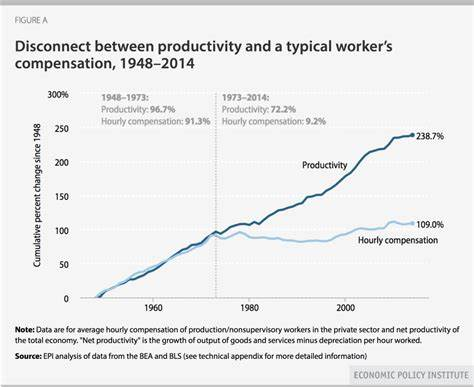
The attached image demonstrates that the working class is getting a short end of the stick. Everyone is working harder and harder for less and less. In times where disparities like this add up, there's often bad times for everyone ahead. The French Revolution was one such time in history, for example.
The Millennials were actually a relative population boom, that's why the generation is called "Echo boom" by some sociologists. But then those kids grew up into situations where they didn't feel they could have kids of their own, and so there's serious problems
[sauce on "echo boom"] https://www.cbsnews.com/news/the-echo-boomers-01-10-2004/
The attached image demonstrates that the working class is getting a short end of the stick. Everyone is working harder and harder for less and less. In times where disparities like this add up, there's often bad times for everyone ahead. The French Revolution was one such time in history, for example.
The half application of Keynesianism is one of my biggest pet peeves in economics and politics.
We just finished having the longest economic recovery ever, and everyone everyone everyone went "we need to spend more money!" the whole time, despite under Keynes the right thing to do was to suck some of the air out of that recovery to save for tomorrow.
We just finished having the longest economic recovery ever, and everyone everyone everyone went "we need to spend more money!" the whole time, despite under Keynes the right thing to do was to suck some of the air out of that recovery to save for tomorrow.
A lot of economists get government spending wrong because telling the government spending too much money and not taxing enough is the right thing to do is a great way to stay employed by the government. Politicians love it, they want to be able to promise all things to all people.
Reality is much more complicated. There's a reason why the workforce labour participation rate is at record lows, labour productivity is plummeting, fertility is below replacement, and so on and so forth.
No matter where the government money goes, it takes up real resources that would have otherwise gone elsewhere. If the government is hiring, then those people get soaked up doing non-productive work. If the government gives money to companies that don't necessarily have the capcity to use it, then either you get stock buybacks or you get companies that get huge and are filled with non-productive or anti-productive people because there's money for it and spending tends to expand to fill budgets. If the government gives money to regular people, then some of those people will decide they don't need to be part of the productive economy.
In all 3 cases, you have people sucking up productivity but not producing any. That might make the numbers go up, but it doesn't improve quality of living for people as a whole.
Now, government spending *can* help improve productivity, but it has to be extremely carefully calculated because government cannot create wealth, it can only pull wealth from one spot and injected it into another spot. Medical doctors often pull something out of one part of the body and inject it into another part of the body and it results in positive results, but if you just do it randomly you'll kill the patient dead.
Reality is much more complicated. There's a reason why the workforce labour participation rate is at record lows, labour productivity is plummeting, fertility is below replacement, and so on and so forth.
No matter where the government money goes, it takes up real resources that would have otherwise gone elsewhere. If the government is hiring, then those people get soaked up doing non-productive work. If the government gives money to companies that don't necessarily have the capcity to use it, then either you get stock buybacks or you get companies that get huge and are filled with non-productive or anti-productive people because there's money for it and spending tends to expand to fill budgets. If the government gives money to regular people, then some of those people will decide they don't need to be part of the productive economy.
In all 3 cases, you have people sucking up productivity but not producing any. That might make the numbers go up, but it doesn't improve quality of living for people as a whole.
Now, government spending *can* help improve productivity, but it has to be extremely carefully calculated because government cannot create wealth, it can only pull wealth from one spot and injected it into another spot. Medical doctors often pull something out of one part of the body and inject it into another part of the body and it results in positive results, but if you just do it randomly you'll kill the patient dead.
I looked at telegram early and saw "Dubai" -- oh yeah, the free speech haven of Dubai. Passed.
The money printing may not have the same effects, but it's all monetary inflation.
Arguably, the effects of the main street bailout were better for the world because at least they were honest. The incredible malinvestment caused by 2008 has demolished many productive industries because not just money but talent has been siphoned off of other things to get lost in the black hole of tech. Hundreds of thousands of the generations smartest people working on chat apps and other useless crap. Trillions of dollars siphoned into useless crap instead of finding additional oil, gas and minerals. A total lack of investment in capital equipment such that key strategic manufacturing can't be done anymore without outsourcing it to our opponent in the next war.
At least the consumer side inflation is honest, it hits you in the face and you have to deal with it.
Arguably, the effects of the main street bailout were better for the world because at least they were honest. The incredible malinvestment caused by 2008 has demolished many productive industries because not just money but talent has been siphoned off of other things to get lost in the black hole of tech. Hundreds of thousands of the generations smartest people working on chat apps and other useless crap. Trillions of dollars siphoned into useless crap instead of finding additional oil, gas and minerals. A total lack of investment in capital equipment such that key strategic manufacturing can't be done anymore without outsourcing it to our opponent in the next war.
At least the consumer side inflation is honest, it hits you in the face and you have to deal with it.
So here's a great example of why I consider the Internet to be a great tool for humanity. We focus so much on the bad things that happen, but look at this! Adrian's Digital Basement is reviewing a super niche computer called the Nabu PC which was a tiny piece of history from the Ottawa area in the early 80s:
https://www.youtube.com/watch?v=HLYjZoShjy0
Well give it just a few days, and this guy DJ Sures has already got it executing code sent from a modern PC!
https://www.youtube.com/watch?v=BupGpbXltqg
https://www.youtube.com/watch?v=HLYjZoShjy0
Well give it just a few days, and this guy DJ Sures has already got it executing code sent from a modern PC!
https://www.youtube.com/watch?v=BupGpbXltqg
It would be nice if more brands realized there's much more to lose than to gain by being cute on twitter.
One important thing to understand is that inflation doesn't always raise prices, and rising prices isn't always caused by inflation.
Inflation is monetary, so the key to inflation is money supply.
To understand how governments and central banks inflate the money supply, you need to understand how money is created. Money is created when a loan is issued. The money didn't exist before, and comes to exist because the banks issue the money for the loan.
Under normal circumstances, there's a few ways a central bank can affect this.
One simple way is Qualitative Easing. This works by directly purchasing loans from banks and effectively replacing the loans with cash. This means that banks have the asset of a loan replaced with a liability of a deposit, so they can go out and issue more loans.
But why would banks need money if they can just create money? Well, that leads into the other way banks can change the money supply, and that's by changing the reserve requirement. The reserve requirement is how much money a bank is required to have on-hand in order to loan out money. The banking system in NZ, Hong Kong, and the US do not have reserve requirements at all at the moment, so theoretically banks can loan out unlimited money.
There's another reason banks need to have money in some form or another, and that's because of risk. Banks can loan money out all day long, but if you default, they take the hit. That's why banks in NZ and the US and HK still give out limited loans, because while they can loan out unlimited money, they can't afford to lose unlimited money. Central banks help reduce this risk because banks can borrow from the central bank as necessary, but all the loans in the world can't help if you've got a negative net worth.
So what can governments do?
Taxing and spending can increase or decrease prices by increasing or decreasing localized demand (this is exactly why you don't hand people money to help with higher prices. Overinflated housing markets around the world all have lots of government programs to "make it cheaper to buy a home", Canada being top among them), but they won't change inflation. The amount of money in the system doesn't really change. The one big thing that government does infuence is debt.
When the government takes out debt, that essentially introduces many, many new dollars to the system which in turn help produce even more dollars through new loans justified because of all the dollars in the system, increasing inflation.
When the government balanced budgets and starts paying down debts, that removes many, many dollars from the system which in turn helps to remove even more dollars from the economy because it's more difficult for banks to justify more loans, decreasing inflation.
At the beginning of this post, I said that higher prices are not inflation and inflation isn't necessarily higher prices, and once you understand that inflation is monetary and the effects of government policies on inflation, you start to see it. Prices happened to stay level for the past 15 years despite wildly inflationary policies around the world because other factors kept prices down.
One continuous impact of inflation is the creation of asset bubbles. Smart money knows it's shrinking in value, so it looks for things that grow in value to preserve itself. When this happens with lots of money at once, it becomes a self-fulfilling prophecy, such as what we saw in tech in the 90s, houses in the 2000s, tech again in the 2010s, and crypto more recently. These things aren't blowing up because they're special, they're blowing up because they're blowing up and the smart money is getting into them to protect itself which is a self-fulfilling prophecy. Money rushes in so prices rise so money rushes in.
I could keep going all day long, but one last thing to think about given my last point: People are pissed off at Elon Musk or Jeff Bezos or Bill Gates or Mark Zuckerberg. Guess what created these mega-rich people? It's inflation. They aren't special, they aren't smarter than people in mining or manufacturing who didn't get to become the richest people on the planet, they just got lucky and the massively inflationary policies since the late 1990s are the reason they could get lucky.
Inflation is monetary, so the key to inflation is money supply.
To understand how governments and central banks inflate the money supply, you need to understand how money is created. Money is created when a loan is issued. The money didn't exist before, and comes to exist because the banks issue the money for the loan.
Under normal circumstances, there's a few ways a central bank can affect this.
One simple way is Qualitative Easing. This works by directly purchasing loans from banks and effectively replacing the loans with cash. This means that banks have the asset of a loan replaced with a liability of a deposit, so they can go out and issue more loans.
But why would banks need money if they can just create money? Well, that leads into the other way banks can change the money supply, and that's by changing the reserve requirement. The reserve requirement is how much money a bank is required to have on-hand in order to loan out money. The banking system in NZ, Hong Kong, and the US do not have reserve requirements at all at the moment, so theoretically banks can loan out unlimited money.
There's another reason banks need to have money in some form or another, and that's because of risk. Banks can loan money out all day long, but if you default, they take the hit. That's why banks in NZ and the US and HK still give out limited loans, because while they can loan out unlimited money, they can't afford to lose unlimited money. Central banks help reduce this risk because banks can borrow from the central bank as necessary, but all the loans in the world can't help if you've got a negative net worth.
So what can governments do?
Taxing and spending can increase or decrease prices by increasing or decreasing localized demand (this is exactly why you don't hand people money to help with higher prices. Overinflated housing markets around the world all have lots of government programs to "make it cheaper to buy a home", Canada being top among them), but they won't change inflation. The amount of money in the system doesn't really change. The one big thing that government does infuence is debt.
When the government takes out debt, that essentially introduces many, many new dollars to the system which in turn help produce even more dollars through new loans justified because of all the dollars in the system, increasing inflation.
When the government balanced budgets and starts paying down debts, that removes many, many dollars from the system which in turn helps to remove even more dollars from the economy because it's more difficult for banks to justify more loans, decreasing inflation.
At the beginning of this post, I said that higher prices are not inflation and inflation isn't necessarily higher prices, and once you understand that inflation is monetary and the effects of government policies on inflation, you start to see it. Prices happened to stay level for the past 15 years despite wildly inflationary policies around the world because other factors kept prices down.
One continuous impact of inflation is the creation of asset bubbles. Smart money knows it's shrinking in value, so it looks for things that grow in value to preserve itself. When this happens with lots of money at once, it becomes a self-fulfilling prophecy, such as what we saw in tech in the 90s, houses in the 2000s, tech again in the 2010s, and crypto more recently. These things aren't blowing up because they're special, they're blowing up because they're blowing up and the smart money is getting into them to protect itself which is a self-fulfilling prophecy. Money rushes in so prices rise so money rushes in.
I could keep going all day long, but one last thing to think about given my last point: People are pissed off at Elon Musk or Jeff Bezos or Bill Gates or Mark Zuckerberg. Guess what created these mega-rich people? It's inflation. They aren't special, they aren't smarter than people in mining or manufacturing who didn't get to become the richest people on the planet, they just got lucky and the massively inflationary policies since the late 1990s are the reason they could get lucky.
It's pretty funny watching these people turn on a dime against one of their previous messiahs.
Imagine having to agree with someone all the time in order to like them.
Imagine having to agree with someone all the time in order to like them.
The one thing that android has that Apple doesn't is the freedom to install what you want. You won't be able to install f-droid on apple, but you absolutely can on android.
It's a thin thread of liberty, but at least it's a thread.
It's a thin thread of liberty, but at least it's a thread.
Can't say much.... My instance allows posts up to 60,000 characters (and occasionally I use them)
I can kinda sorta see it.
Like, "Oh, this is for adding a post to my favorites, but I don't want to add any posts to my favorites it's not like I'll go back and look at them"
Sometimes too much experience with other stuff can make intuitive stuff less intuitive because your previous experience misleads you.
Like, "Oh, this is for adding a post to my favorites, but I don't want to add any posts to my favorites it's not like I'll go back and look at them"
Sometimes too much experience with other stuff can make intuitive stuff less intuitive because your previous experience misleads you.