
Neither is correct.
440m underground is deep enough that you're well under the cold temperatures immediately underground, but not so deep it's painfully hot. It's probably a super stable temperature year round, and you could probably spend all day every day at 440m and the worst you'd have is it's pretty stuffy being surrounded by rock. Ventilation is key in something like that, because it'd be humid and without getting fresh air it gets stale and eventually could get quite dangerous as well.
440m underground is deep enough that you're well under the cold temperatures immediately underground, but not so deep it's painfully hot. It's probably a super stable temperature year round, and you could probably spend all day every day at 440m and the worst you'd have is it's pretty stuffy being surrounded by rock. Ventilation is key in something like that, because it'd be humid and without getting fresh air it gets stale and eventually could get quite dangerous as well.
Pretty impressive for a guy who had one joke one time and has stretched it into an entire career.
As part of an ongoing project I have been setting up various flavors of BSD.
Freebsd, openbsd, netbsd, and dragonfly bsd. Nothing particularly fancy, they are all just living in virtual machines.
Unix is Unix, but it's surprising how different each one is. Freebsd was The most straightforward so far, feeling the most familiar and straightforward. OpenBSD so far has been the most difficult to develop on because it has a lot of security features as mandatory that other OSes recommend set as default. Dragonfly has a lot of similarities with freebsd, but in trying to set it up feel like I was back in 1996, fumbling with manual config files only to have no keyboard or no mouse for reasons known only to God.
Another big difference between them is how they manage current versions of things. Freebsd maintains 3 different version lines going back several years, but openbsd is standardized on whatever the current version is.
Something that is constant between Linux distributions is the Linux kernel, so you can chroot between distributions which is convenient for compiling between distros, whereas BSDs are basically their own thing and each kernel is unique with a long individual genetic line.
Freebsd, openbsd, netbsd, and dragonfly bsd. Nothing particularly fancy, they are all just living in virtual machines.
Unix is Unix, but it's surprising how different each one is. Freebsd was The most straightforward so far, feeling the most familiar and straightforward. OpenBSD so far has been the most difficult to develop on because it has a lot of security features as mandatory that other OSes recommend set as default. Dragonfly has a lot of similarities with freebsd, but in trying to set it up feel like I was back in 1996, fumbling with manual config files only to have no keyboard or no mouse for reasons known only to God.
Another big difference between them is how they manage current versions of things. Freebsd maintains 3 different version lines going back several years, but openbsd is standardized on whatever the current version is.
Something that is constant between Linux distributions is the Linux kernel, so you can chroot between distributions which is convenient for compiling between distros, whereas BSDs are basically their own thing and each kernel is unique with a long individual genetic line.
You ever been about half way through something and started to be like "am I the first person on earth to have done this? There's no way the devs intended this to be the process for making this work!"
"Chronic deficits cause inflation that disproportionately hurt the poor and middle classes are required so the government can pay for:"
You know what's really really gay? Having a strong opinion about what 4 billion men do with their pee pee.
My next book talks about how Tate is essentially the feminized version of masculinity, and it was just takes a few steps further. We get it bro, you were raised by a single mom. Holy shit do we ever get it.
My next book talks about how Tate is essentially the feminized version of masculinity, and it was just takes a few steps further. We get it bro, you were raised by a single mom. Holy shit do we ever get it.
Part of me thinks there could be a really cool vampire story about two different people, one of them taking the opportunity of living forever to become a polymath, extending the positives of humanity well beyond the capacity of us single lifespan, and the other taking the opportunity of living forever to become the ultimate entitled loser, having seen the wealth of tamberlane or the khans and resenting that they don't have a slice of the pie that big.
It's a generic android set top box running on a p281 reference board, apparently using an s905x chip.
Normally you'd press a reset button with a paperclip or toothpick to get it to try to boot off the SD card, but I ended up writing the sd card dozens of times trying to get it going so I drilled the reset button hole and printed a little button (the blue thing sticking out of the side).
Two distributions generally work on these out of the box: CoreELECT which provides a basic experience with kodi, and armbian which provides Ubuntu or debian support.
Neither worked out of the box for me. The armbian distribution written by the armbian app had a lot of complexity but didn't work, and the coreelect didn't either. What I eventually found was ta LibreElec-Generic-S905-9.2.8.19.img file which didn't work out of the box but did hard lock on boot up (which was progress -- the two behaviors before that were either skipping SD booting altogether and loading the android update app or boot looping). I found out that on that one you have to pull the correct .dtb file and copy it to dtb.img on the root of the card, and that one worked, which was a big deal.
That dts file seems really critical. Arm isn't standardized so before you even load a kernel it describes the way stuff is laid out. Finding a working dts file ended up being a key to getting it to boot at all.
Shortly afterwards I found amlogix-s9xxx-armbian by ophub on GitHub, and it didn't work directly but I was able to get an image from that repo to write and then boot using the dts file I got from the libreElect distribution. It seems to support basically all the hardware, after I got everything set up using the ethernet port I was able to get it onto my house WiFi.
It all works, but the 1GB of memory, limited CPU, and the fact everything is running off an SD card means it doesn't feel very snappy. However, the fact that this tiny little box is now a functioning PC is very cool to me, and if I take the SD card out, it returns to being an android set top box.
Normally you'd press a reset button with a paperclip or toothpick to get it to try to boot off the SD card, but I ended up writing the sd card dozens of times trying to get it going so I drilled the reset button hole and printed a little button (the blue thing sticking out of the side).
Two distributions generally work on these out of the box: CoreELECT which provides a basic experience with kodi, and armbian which provides Ubuntu or debian support.
Neither worked out of the box for me. The armbian distribution written by the armbian app had a lot of complexity but didn't work, and the coreelect didn't either. What I eventually found was ta LibreElec-Generic-S905-9.2.8.19.img file which didn't work out of the box but did hard lock on boot up (which was progress -- the two behaviors before that were either skipping SD booting altogether and loading the android update app or boot looping). I found out that on that one you have to pull the correct .dtb file and copy it to dtb.img on the root of the card, and that one worked, which was a big deal.
That dts file seems really critical. Arm isn't standardized so before you even load a kernel it describes the way stuff is laid out. Finding a working dts file ended up being a key to getting it to boot at all.
Shortly afterwards I found amlogix-s9xxx-armbian by ophub on GitHub, and it didn't work directly but I was able to get an image from that repo to write and then boot using the dts file I got from the libreElect distribution. It seems to support basically all the hardware, after I got everything set up using the ethernet port I was able to get it onto my house WiFi.
It all works, but the 1GB of memory, limited CPU, and the fact everything is running off an SD card means it doesn't feel very snappy. However, the fact that this tiny little box is now a functioning PC is very cool to me, and if I take the SD card out, it returns to being an android set top box.
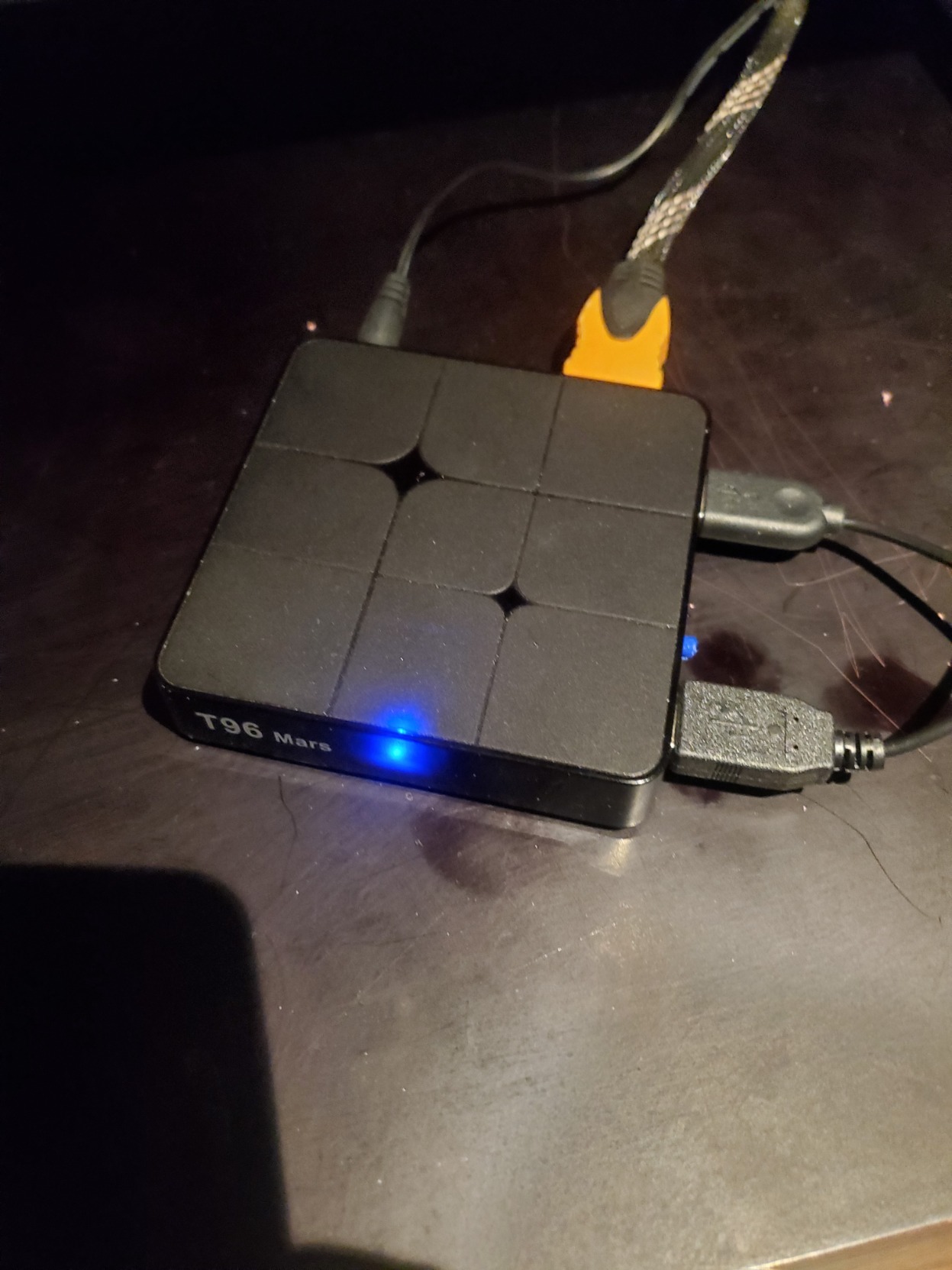
Successfully got this android set top box from 2018 running Ubuntu. Arm64 quad core and 1GB of memory but it's got two USB ports and lots of connectivity so it's a neat little thing to have running a desktop OS.
Once again watching so-called anti-fascists bend over and lick the boot with respect to mandatory age verification in their FOSS operating systems.
Every tiem
Every tiem
The oldest known banksy is from the 90s.
What else was banksy going to be but old? Time doesn't stop just because you're famous.
What else was banksy going to be but old? Time doesn't stop just because you're famous.
Every time I deal with arm linux, it reminds me of why every time I see threats to move away from x86 it gives me the chills in a bad way.
I could build a USB memory stick that would run on a particularly unusual Pentium 3 (since most Pentium 3s didn't have boot from USB) and would be fully capable of booting on every machine released since. Meanwhile, every memory stick that I create for arm needs to be so incredibly specific that just making bootable media is the single most difficult part.
It's kind of a shame because arm has some really cool features that would potentially make it really useful, but without the surrounding ecosystem it's just not a single thing.
I could build a USB memory stick that would run on a particularly unusual Pentium 3 (since most Pentium 3s didn't have boot from USB) and would be fully capable of booting on every machine released since. Meanwhile, every memory stick that I create for arm needs to be so incredibly specific that just making bootable media is the single most difficult part.
It's kind of a shame because arm has some really cool features that would potentially make it really useful, but without the surrounding ecosystem it's just not a single thing.
If it makes you feel better, my gentoo life started on a single core 800Mhz duron so I feel your pain.
It won't be a VPN ban, because of VPN ban would immediately impact millions of people in the laptop classes which includes millions of people who work for the government.
It'll be a ban on using VPNs for unapproved purposes.
Which in some ways is much worse because it's like a digital feudalism.
It'll be a ban on using VPNs for unapproved purposes.
Which in some ways is much worse because it's like a digital feudalism.
Even before 2020, I did some quick calculations showing that the idea that inflation was 2% per year was absolutely absurd. Especially in my neck of the woods, every bill has gone up multiples, and groceries are the worst. Meanwhile, they need to pretend that inflation was 2% that whole time because otherwise everyone's going to point out that my country's economy has been in freefall for decades.